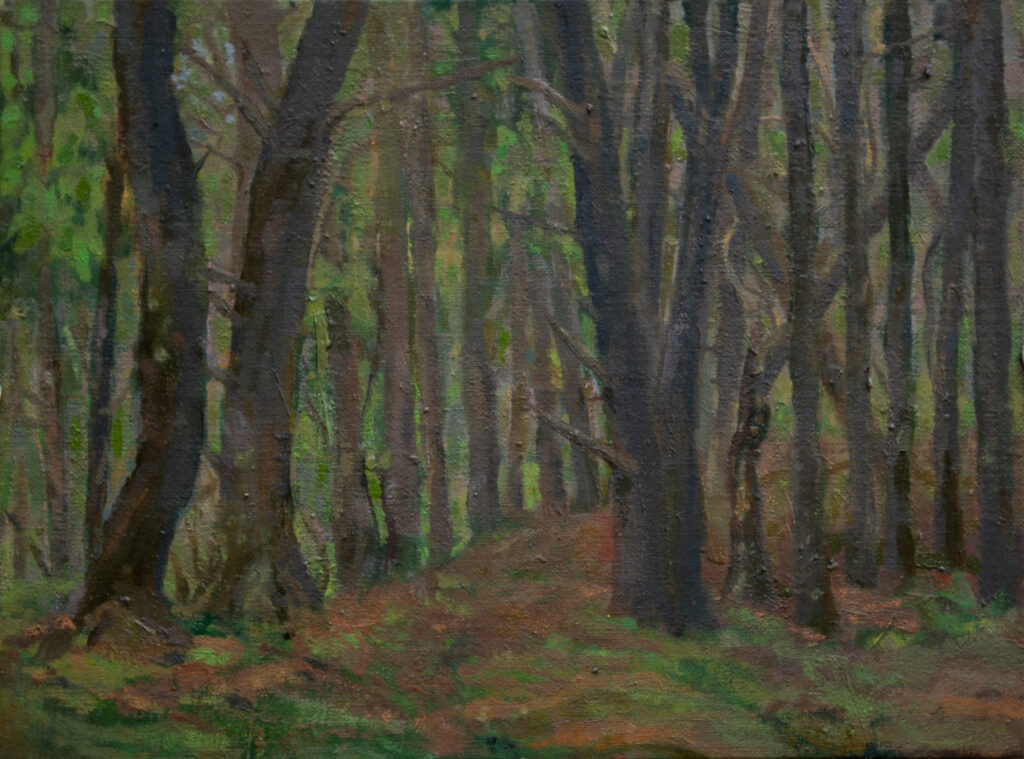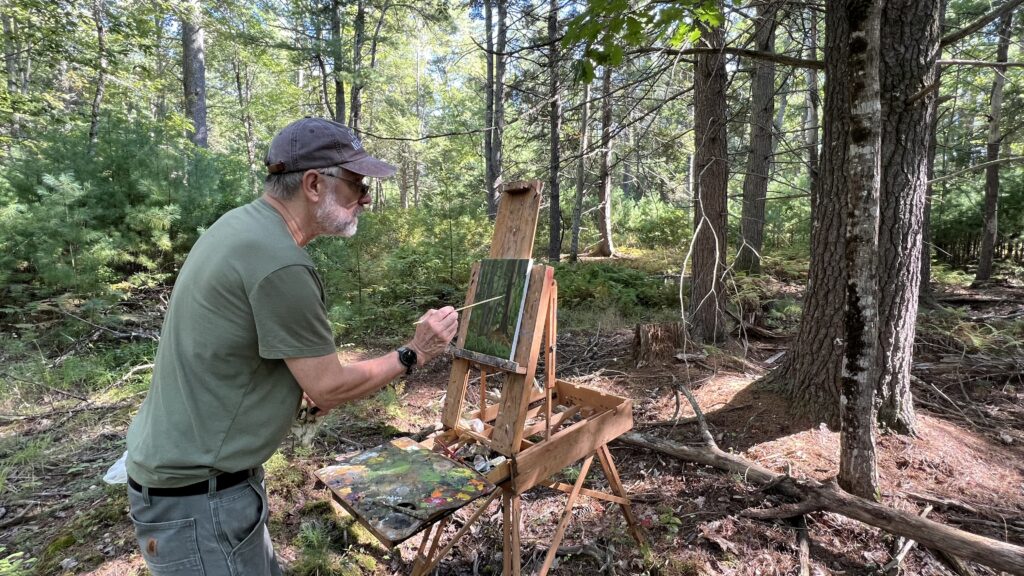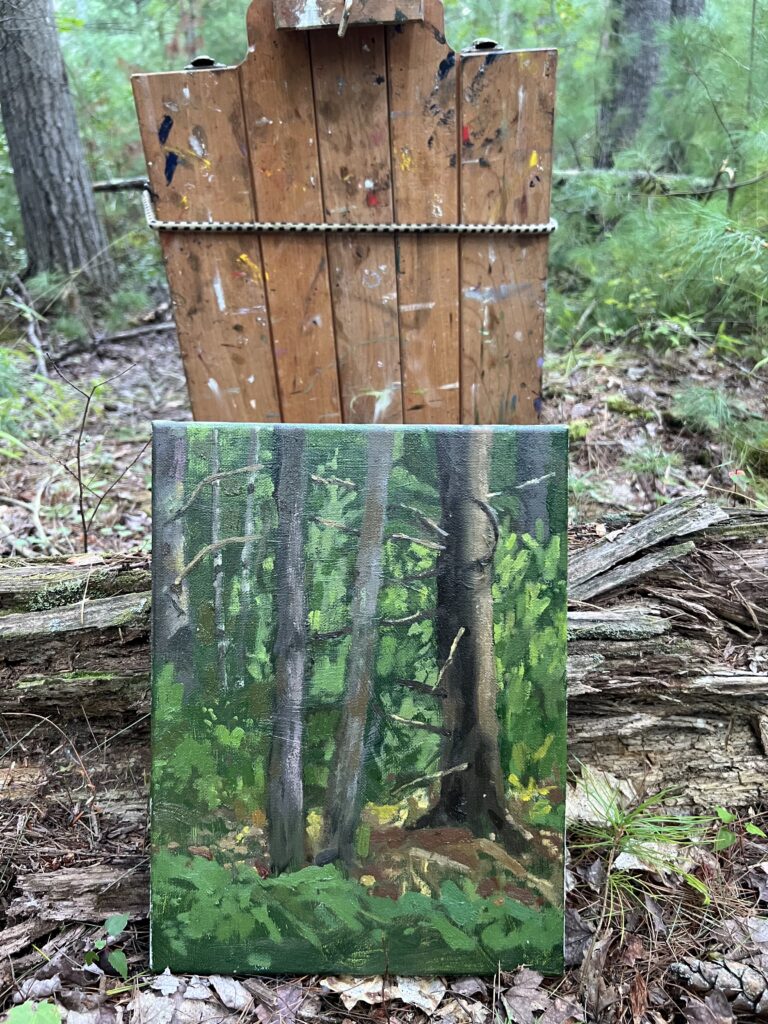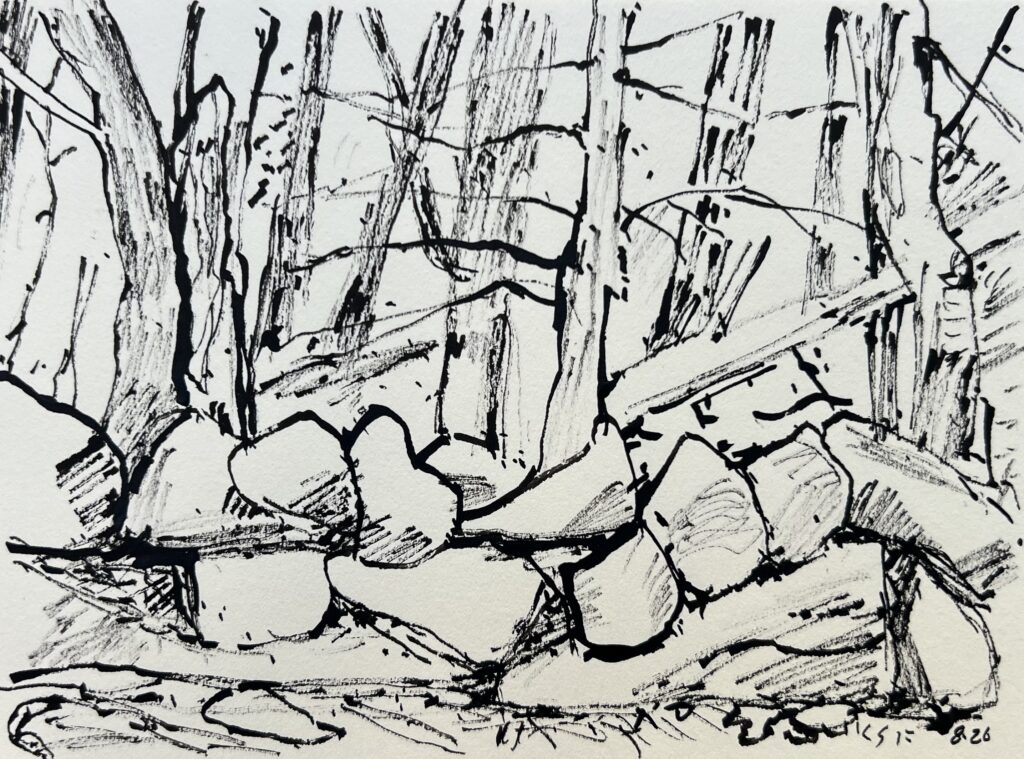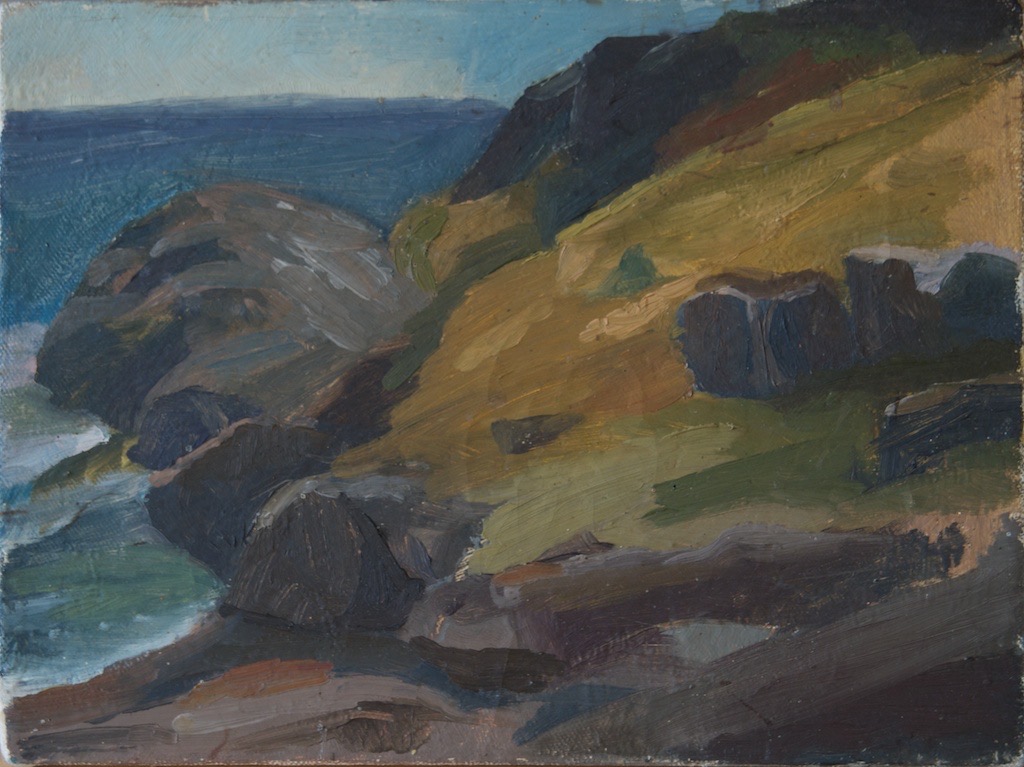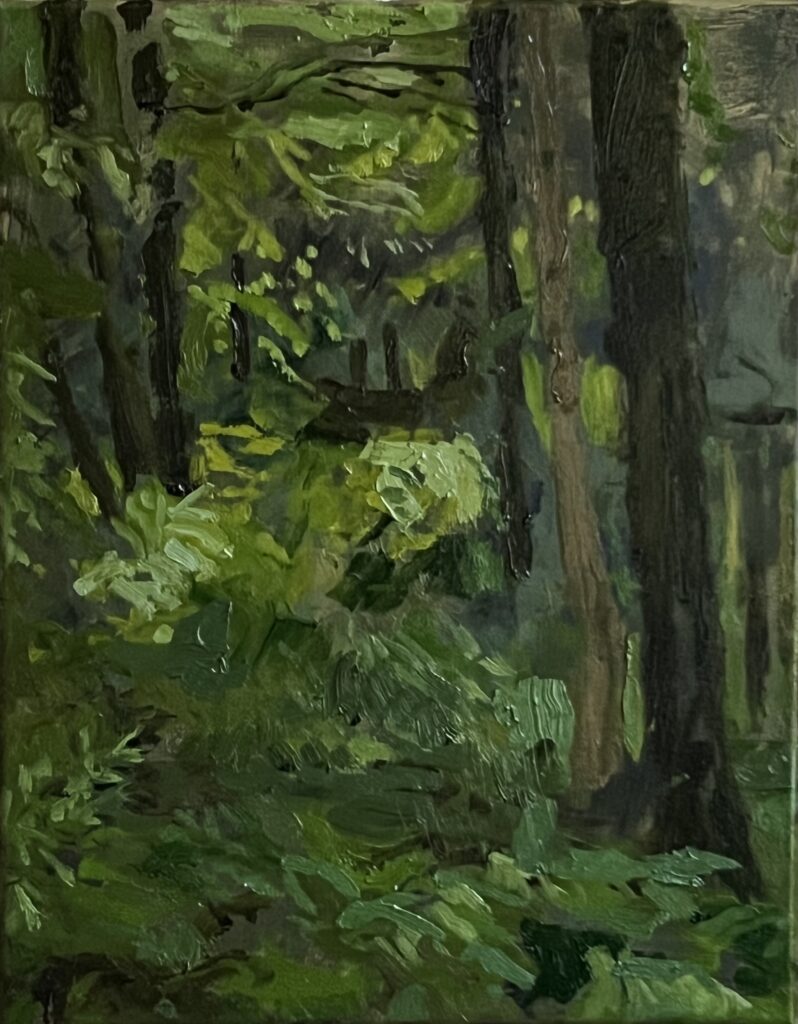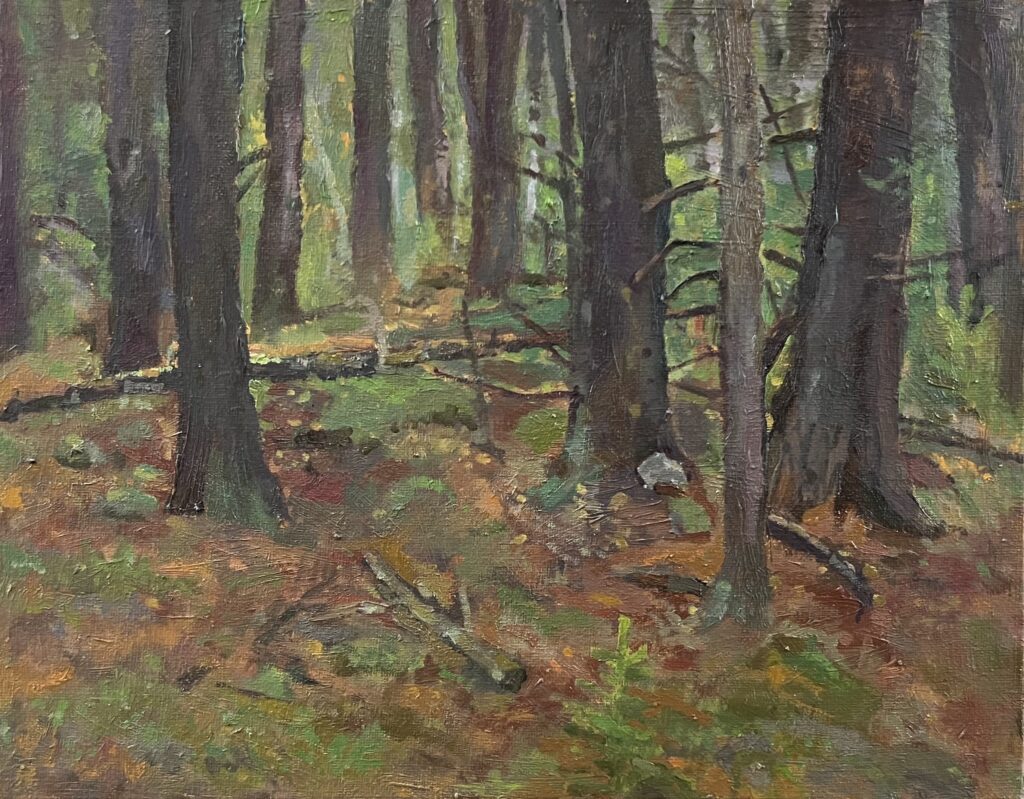

Yesterday, I had a studio visit with my friend, Tony. We spent a few hours catching up and exchanging ideas about painting. Over a year ago, Tony invited me to his studio for a visit and prior to that Tony attended a “Show and Tell” at Freeman Gallery. Tony and I were both on the Board of a local non-profit which is where I got to know him. When on the Board we quickly realized we were both creative spirits and I have always looked forward to seeing and talking about art with him. Tony is also an art conservator—so he looks at art quite differently than I do. I think in comparison I don’t think about art as commodity.
Tony has become a friend over the years, and I feel quite comfortable and excited to exchange ideas with him. With that said, I am quite introverted with my paintings and other creations. I don’t feel a strong desire to get them out there, into a gallery. Over the years I have become OK feeling this way. I have always painted to explore possibilities and marketing and sales of my painting just doesn’t get me up in the morning, so I come up short with galleries and the like. And for me, this causes a difficult problem, not only does my work not sell, but only one or two people see my paintings. Hence, there is a never ending supply of new paintings and drawings piling up everywhere. This doesn’t make me feel happy, as I feel in a way I am wasting our planets resources. But I haven’t stopped, so far.
These two aspects of painting Tony and I really keyed in on—creativity and selling art. We began by talking about how artists rise to the top and it is often not obviously based on merit. As we drilled down, what is merit to an artist? Is it a two dimensional surface that “works?” What does it mean for a painting to work? I told Tony, in my education I was told a painting had to have a unified surface where every brush stroke was integral to every other brushstroke, and only then would a painting be worthy of being complete. This idea obfuscates the other likely relevant aspects of a painting. For example, the emotional trigger that perhaps inspired the work. In my painting classes at PSA (Portland Museum of Art; currently MECA&D) there was confusion among the faculty of what worked. We had the benefit of many instructors walking through the studios. They would stop and comment on painting and sing praises for work that other instructors dispelled as incomplete or lacking in composition. At first these contradictions seems ironic. Gradually, however, I realized they were the norm.
Back to my conversation with Tony… Who decides what artists are selected over other artists and by what basis. In the high stakes markets of Southby’s and Christie’s, I dare say money dictates. If art is a commodity it needs to be part of a business strategy. And as this cog spins those responsible are the gallerists and business partners. At this point if a painting works or not gets lost in the sea of money. As Tony pointed out to me, some artists do make some excellent paintings but the majority of their work could be “terrible,” non-the-less, consumers are willing to pay premium prices for good or bad work.
When I say good or bad work, I mean to say that some work is obviously stronger than other work and even if someone does a so called weak painting I applaud them for trying. By applying academic principles to art I feel that it can be belittled. Ultimately, beauty is in the eye of the beholder. This is apparent in local galleries as it is in major institutions. People are entitled to like a painting just because they do. And if enough people like an artists work it elevates the artist and interest is found.
Additionally perceptions are allowed to change. We may respond in one way to a painting and see it differently after having a conversation about it. A painting can take on a whole new life as our lives evolve and we have more experiences. It is refreshing that no two people paint the same way. There are so many variations for an individual to express their uniqueness that painting to look like another artist would take dedication and practice. As much as we like to categorize and announce a painting works it is really missing the point.
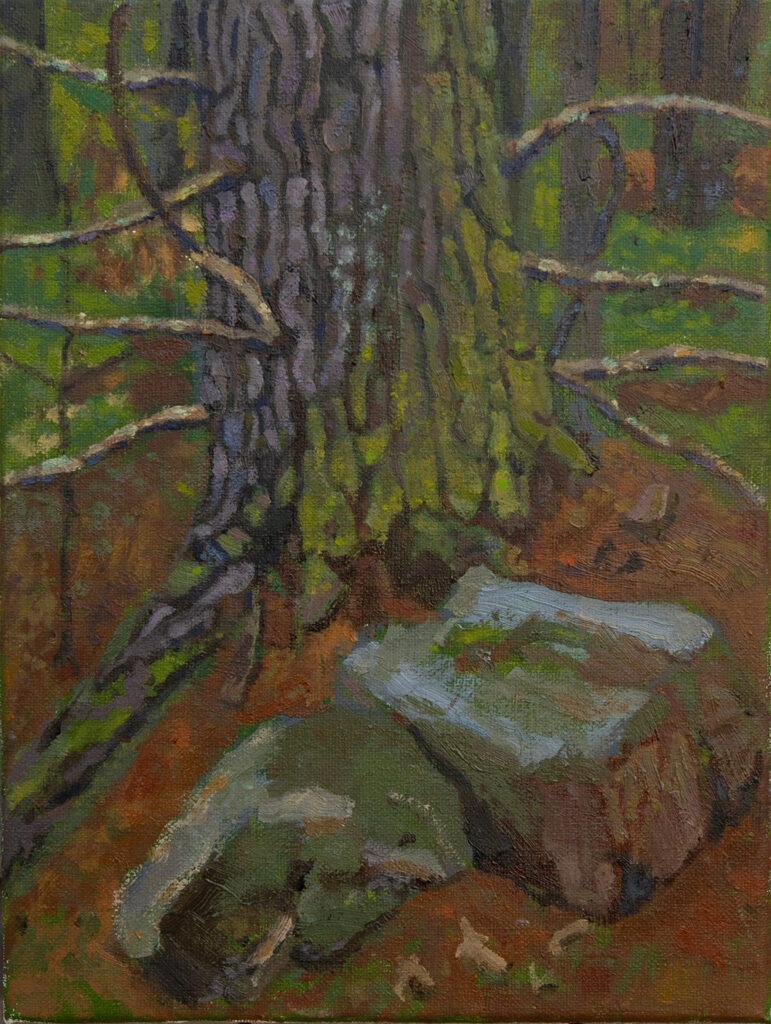

The inspiration for one to paint can be varied but ultimately individual needs dictate and most often the need is met by trying to express an emotion. Can art be created without emotion? I suggest that without emotion it would be a product of skill, perhaps craft. I don’t feel that there is a way to make an objective evaluation on a work of art. Certainly viewers can reach a consensus and there will always be naysayers.
Tony and I talked about the role Johanna van Gogh-Bonger had on the legacy of Vincent Van Gogh. Vincent was mostly underrated by his contemporaries. He sold one or two paintings in his life time. He left behind about 900 paintings and his sister in law, also known as Jo, took it upon herself to market his genius to the masses, something her husband Theo could not do in his gallery. One wonders how Vincent became a household name within a century of his death and is his popularity based on the merits of his painting or also on the idea of his story? There are numerous stories that seem to provide an enhanced fascination to an artist’s legacy.
Chatting with Tony gave me a lot to think about and appreciation for his knowledge of many of the so called great artists. Art brings so much richness to the creator and the viewer that it is impossible for me to make any clear arguments. But recalling the quote by Joseph Campbell, “follow your bliss,” I am inspired to get up from my chair and go into my studio and observe the paint flow from the brush.